Taquitos from Tortilleria Los Gemelos in Port Chester
Posted: December 4, 2008 Filed under: Food | Tags: mexican, port chester, tacos, taquitos 1 CommentIf there’s one thing that’s in short commodity out here in the North East when it comes to Mexican food, it’s consistency. A place that is good one week seems to be terrible the next. So a restaurant or taqueria that can consistenly turn out great tacos, month after month, year after year, is a real treasure.
Which is why, of all the tacos places I’ve tried in the NY Metro area, Tortilleria Los Gemelos in Port Chester is the one I’ve been going back to most consistently since I first tried it back in 2002.
I’ve seen this place go through a lot of changes. At first – when it was named Tortilleria El Paisano (if I remember correctly) – it was just a bare-bones tortilla factory with tables and chairs that served basic taqueria food. The walls were white and bare and the ceiling looked like an old factory ceiling. Slowly they’ve transformed – painting the walls a festive color, redoing the ceiling, changing the name, expanding their menu, redesigning the seating to have permanent booths (which, by the way, are the most uncomfortable booths known to man). They’ve gotten a little more expensive, but their food has remained consistently good.
About a year ago they started offering taquitos, which are nothing more than small tacos (hence, the name), similar to what you find throughout Mexico. Since I usually order regular tacos, sopes or tortas there, I’ve avoided the taquitos. But on Tuesday this week, I decided to order three taquitos – carnitas, al pastor, and cecina.
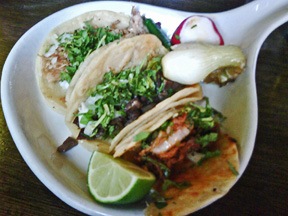 Wow, I was surprised at how good they were. In fact, they may have been the best tacos I’ve ever had there. And keep in mind, I’ve had, literally, hundreds of tacos from this place.
Most importantly, the tortillas were perfect. I know they don’t hand make their tortillas, but they do “housemade” them. In other words, this place always have fresh tortillas because they make them there and you can see them running off their conveyor belt. These small tortillas were more tender, and more toothsome than I ever remember their tortillas being. They were slightly thicker and cooked to perfection on the griddle with a little oil to give them tender flavor and texture.
And the fillings were done perfectly. Their al pastor, which has never been their strong suit, was well flavored and slightly charred – a nice touch since they don’t use a spit. Their carnitas, always their best choice, was perfectly tender, moist and flavorful without any hint dryness. And yet, it wasn’t overly rich either. And the cecina taco was good too, though not as memorable as the other two.
So, while Los Gemelos isn’t new by any stretch, it’s good to know that some places are still producing great Mexican food, seven years on.
Tortilla Los Gemelos
In honor of El Charrito taco truck in Stamford, CT
Posted: November 29, 2008 Filed under: Food | Tags: al pastor, carnitas, el charrito, hamburguesa, huarache, mexican, oaxaquenos, pescado, quesadilla, sincronizada, sope, tacos, tamales, tortas 9 Comments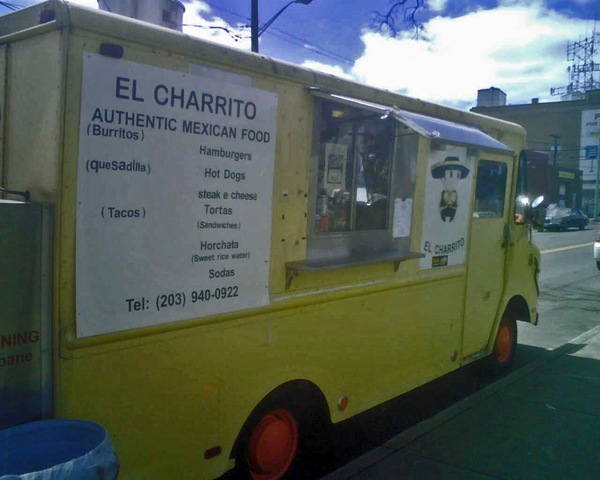 So, I found out last week that El Charrito is going to close up for the winter. I’m not sure what I’ll do for tacos from now until March. After all, they’ve been the only taco I’ve had in Stamford since I discovered them a year and a half ago. But, while I wait until they reappear in March, I figured I’d recap everything I’ve eaten there:
Huaraches – Although my first ever experience at El Charrito consisted of  tacos (when they were still hanging out in the the Shop Rite parking lot), it wasn’t until I had the huaraches in their current location that I was really sold on this place. Their huaraches are thick, sandal-shaped, semi-hard and chewy tortillas smeared with refried beans, meat of your choice, lettuce, cotija cheese, crema, avocado and salsa. These huaraches are very, very good. They aren’t stuffed huaraches like you find in some places where the “tortilla” (for lack of a better term) is filled with beans or meat inside (ala pupusas, but thinner). Nevertheless, these huaraches are very good. At about 9 inches long, these make a pretty good meal unto themselves. $4.50 each
Sopes – really, at El Charrito, sopes are about the same as huaraches, just smaller and round with a slightly thicker tortilla. Excellent.
Tostadas – a different vehicle, but the same formula as sopes and huaraches, with beans meat of choice, lettuce, crema, salsa and cotija cheese. And, like the others, they are very, very good.
Tacos – The tacos are very good at El Charrito. I haven’t tried every variety, but I’ve come really close. So far, I’ve sampled carne adobada (marinated pork), al pastor (another marinated pork, though not spit-roasted like traditional Mexican al pastor), bistek (beef), cecina (salty beef), pollo (chicken), lengua (beef tongue), carnitas (slow-roasted pork), pescado (fish) and pescado al pastor (fish cooked “al pastor style” with pineapple). All of them are good. The standouts for me though are the carnitas and the two fish tacos. The carnitas are good, rich and moist. Sometimes the chunks of fat – intentional with carnitas – are a bit too big, so I’ve got to pick them out, but otherwise, no complaints. And the fish tacos… well, they are excellent. Tender chunks of marinated white-fleshed fish, cooked to perfection. These aren’t baja style fish tacos, which are battered, deep fried fish filets, topped with cabbage and a spicy crema. But they are excellent nonetheless. $2.50 each
Tortas – tortas are the ultimate lunch fare. Big Mexican sandwiches, on a big roll, griddled, slathered with refried beans and filled with queso fresco-style sliced cheese, lettuce, avocado, jalapeños, cotija cheese, salsa, and a huge pile of whatever meat you choose. My favorite torta is always the carnitas torta. El Charrito’s is huge and messy. Get extra napkins and watch out for spilling on your suit. I’ve had more than one trip to the dry cleaners as a result of their tortas. $5.50 each (I think)
Quesadilla – these are a real treat. Put out of your mind the flour tortillas that you find at most places or make at home. At El Charrito, quesadillas are made from huge hand made corn tortillas, probably 12 inches wide, delicately cooked on the griddle, then folded over and filled with the meat of your choice, some Oaxacan cheese (I think, as it resembles mozzarella in taste and texture ), and other goodies. I think they serve gringo style quesadillas too, so make sure you order quesadilla ala Mexicana. $4.50 each
Hamburguesa – As much as I might say the tortas are messy, the hamburguesas make the tortas seem downright tidy. These are hamburgers with a true Mexican spin – spicy mayo, sliced jalapeños, avocado, etc. These would be the best hamburgers in town, except the quality meat they use isn’t the best. I’m not positive, but it seems they just use normal pre-made beef patties similar to what you find from Costco. If they upgraded to some great ground beef, these would be amazing. They still really hit the spot, but until they upgrade the beef, they aren’t the best thing on their menu by any stretch. $5 (I think)
Tamales – Tamales are only sold at El Charrito on Saturdays, but they are worth the week-long wait. The only tamal they offer is the Oaxaqueño variety – either chicken or pork tamales wrapped in banana leaves rather than corn husks. If you’ve never had a Oaxaqueño style tamal, it’s worth the effort to hunt them down. The banana leaf imparts a unique earthy flavor, and the masa is much smoother and much softer than the more toothsome corn-husk tamal. While I wish these were the real traditional Oaxaqueños, replete with mole negro, they are still wonderful in their salsa verde or salsa rojo form.
Sincronizadas – The best way to describe these are a cross between a quesadilla and a ham and cheese sandwich. In Mexico, the ones I had were made with small flour tortillas, with thin slices of ham, queso amarillo (yellow American cheese), pickled jalapenos and avocado. They may not sound very good, but they are surprisingly addictive. At El Charrito, sincronizadas are made with flour tortillas, with a stringier cheese (probably Oaxacan), refried black beans, and thin slices of ham. That’s pretty much it. I can’t say it’s my favorite thing at El Charrito, but it can be satisfying in a guilty pleasure, comfort food kind of way. $4.50
Burritos – These are the only glaring omission in my list, as I’ve yet to try them at El Charrito. I fear this has more to do with psychology than anything else. Over the years I’ve developed such an aversion to burritos that I just can’t bring myself to try them any longer. Maybe if I were hanging out in Texas or Northern Mexico, where burritos are legitimate components of the traditional regional cuisine, but anywhere else, I just see burritos as an appeasement for the gringo. I realize how silly and elitist that sounds. But I can’t help it. So, I can’t report on their burritos.
Whew… that made me tired. And hungry again.
UPDATE: I went by for some dinner tonight and found out that they’ve changed their plans and no longer are taking the entire winter off. Instead, they’ll be around until January, then will be leaving for Mexico for about three weeks. Then they’ll be back in business. So, Stamford folks, no need to lament a loss of tacos for the entire winter.
Scouting the best empanadas in Westchester County – an interim report
Posted: November 23, 2008 Filed under: Food | Tags: Argentine, Briarcliff Manor, Chilean, empanadas, Guatemalan, Inca y Gaucho, Los Andes, Med, Mt Kisco, Ossining, Paraguay, port chester, Quimbaya, Sleepy Hollow, Tango Grill, Westchester County, white plains 9 Comments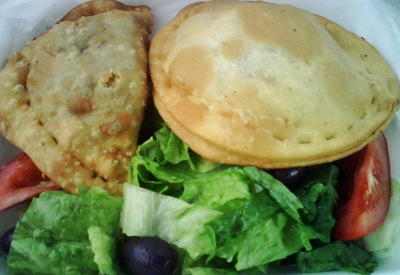
Lately I’ve had a hankering to do some deep food exploration in Westchester. It has now been nearly a year since I wrote up the report for Westchester Magazine’s “Eater” blog about the State of the Taco in White Plains.
Feeling the itch to go much deeper in the exploration, I’ve decided to take it on myself to try every empanada humanly possible in Westchester County to find where – or if – greatness exists in the realm of the wonderful Latin American turnover.
As usual, I started this quest with a query to Chowhound. Based on some previous notes, and some of the suggestions coming from that thread, these are the places currently on my target list.
- Los Andes Bakery, Sleepy Hollow, NY (map)
- Asi es Colombia, Port Chester, NY (map)
- Pollo Ala Brasa Misti Restaurant, Port Chester, NY (map)
- Quimbaya, Ossining, NY (map)
- Med, Briarcliff Manor, NY (map)
- Chapines Deli, Mt. Kisco, NY (map)
- Inca y Gaucho, Port Chester, NY (map)
- Panaderia Uruguaya, Port Chester, NY (map)
- La Nueva Puebla, White Plains, NY (map)
- Little Paraguay Deli, White Plains, NY (map)
- Tango Grill, White Plains, NY (map)
I know there are more places with empanadas in Westchester County (afterall, pretty much every Latin restaurant of any kind has them), but these are the ones I’m focusing on right now.
Sadly, I’m less than half way through the list. In the past three weeks, I’ve tried Panaderia Uruguaya, La Nueva Puebla, Inca y Gaucho, Los Andes Bakery and Med.
I won’t go into specific notes, but here are a few observations.
There is simply no replacing empanadas that are cooked on site. And based on my recent excursions and prior visits, only about 1/4 of the restaurants around here actually make their empanadas on site. Quality suffers dramatically as a result. Also, I’ve noticed a distinction within this phenomenon. In general, fried empanadas are made on site, while baked empanadas are cooked somewhere else. As a result, the baked empanadas are really coming up short. That’s too bad, because a great baked empanada is one of the best treats in life.
So, I’ll have much more detail to my notes in a few weeks. In the meantime, I’m sampling the untested places on my list, as well as exploring if I’ve missed some places on the list altogether. Ideas? Let me know…
Like to swim but afraid of the ocean? Taking an inside-out approach to social media
Posted: November 21, 2008 Filed under: Work | Tags: corporate, culture, e2.0, enterprise 2.0, IBM, socialmedia, swim, web 2.0 2 Comments
Photo courtesy of David Sifry via Flickr
My wife grew up a surfer. In high school, she’d ditch 4th period to head to the beach with her friend and her friend’s 9-foot longboard and surf the rest of the afternoon.
Some time during her senior year, she had an incident with a shark. Terrified, she paddled to shore as fast as she could. It turned out the shark was actually a playful dolphin circling underneath her board, but the result was the same. She never surfed again.
That doesn’t mean she is afraid of water or doesn’t love to swim. She’ll spend the entire summer in the pool. But when it comes to the big, deep blue ocean, she won’t go in past her waist.
Some people love to swim, but they are afraid of the ocean. Let me try and relate this to social media within the enterprise.
Those of us responsible in some way for driving adoption of social media within the enterprise face many of the same challenges. Foremost is overcoming the fear some employees – and companies – face when it comes to social media. Many harbor fear that Web 2.0 is a dangerous jungle with hazards lurking in every shadow. This fear can largely be overcome by providing a safer environment where people can learn, practice and experiment.
This has significant effect at the executive level too. As executives see social media work constructively inside the company, they begin to feel less need to control and more comfortable taking risks associated with new levels of openness and collaboration.
IBM’s approach – inside-out first
I wasn’t involved when IBM first dabbled its toes in the social media waters six years ago, so I can’t relate all of the discussions that went on at the time. But what I do know is this: the company made a deliberate decision to start our efforts inside the company first. We are a company of 380,000 employees, spread across the world, so it made sense for us to start our efforts inside the company – to find ways to connect more meaningfully across the world, to collaboration more effectively, and to flatten a massive organization.
(I’ll spare the lengthy discussion of what exactly we’ve been doing behind the firewall, but you can read about it here in Shel Israel’s interview with my colleague George Faulkner.)
This doesn’t mean that we haven’t done considerable work outside the firewall too. But our staring point was driving the adoption of social media inside the firewall first.
What has been the result? A culture within IBM familiar and comfortable with engaging in social media. As a whole, I think we are pretty advanced in our thinking of how to use these tools. We aren’t perfect, and I still see examples that make me cringe, but for the most part, the company is smart in its use of social media.
What does this mean for everyone else?
Adopting these tools and platforms behind the firewall first creates a safe environment where employees can safely learn the basics of social media without the fear of wading into the deep waters of a shark-infested ocean.
Employees will learn how to engage constructively with one another and behave in a way conducive to collaboration and openness. I can’t help but think many companies could avoid a lot of the embarrassing mistakes I see if employees had been able to experiment and learn behind the firewall first.
I realize that this approach doesn’t work for all companies. Perhaps their greatest needs are external and they need to address them immediately. IBM’s approach is IBM’s approach. But I can’t help but thinking that if more companies actively worked to create a safer environment within a company for employees to experiment and learn, they’d avoid many of the embarrassing mistakes that too often plague corporate use of social media.





 Adam Christensen