Homemade empanadas
Posted: December 31, 2008 Filed under: Food | Tags: empanadas, homemade 6 CommentsAfter two-months of hunting for the best empanadas in Westchester County, I am finally ready to type up all my notes and put together my report. However, in the meantime, I’d just like to state that I’m pretty proud my own homemade empanadas would hold up really well compared to the best around:

At the top of my to-do list
Posted: December 16, 2008 Filed under: Food | Tags: Colombian, Food, Guatemalan, guatemelteco, lunch, mexican, port chester 3 CommentsI’ve been on a Port Chester binge lately. And in delving deeper into PC goodness, I’ve been tripping over some new places that I’m dying to try. If only I didn’t have pesky work (or limited cash), I’d try them today. But in the meantime, here are the three places now at the top of my to do list:
- Rancho Grande, 8 Poningo Street, Port Chester, NY
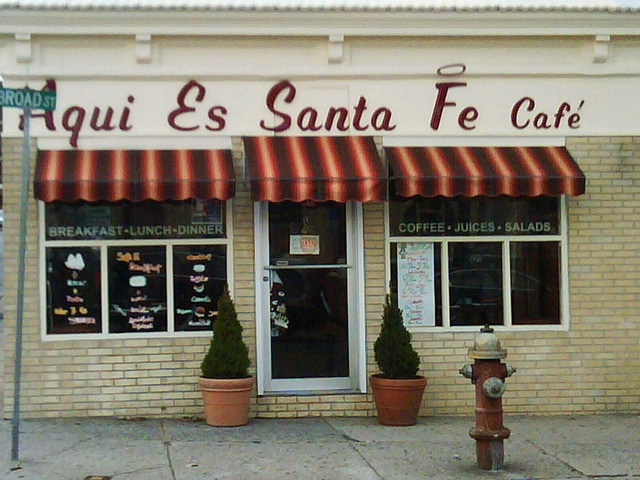
This is a little Mexican place that always seems so lonely I feel guilty not going in and trying it out. Every time I pass by, one of the owners is peering out the window like a puppy dog waiting for an owner. If for no other reason than to absolve myself of guilt, I need to try this place. - Aqui es Santa Fe Cafe, 32 Broad Street, Port Chester, NY 10573 (914) 305 1060
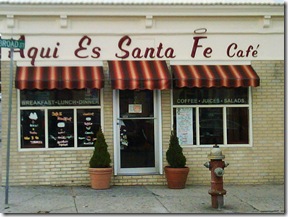
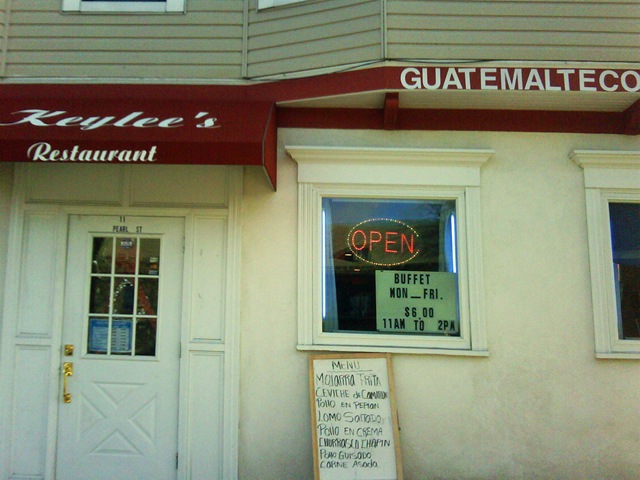
I wrote up more about this place here on Chowhound, but, briefly, it’s a nice, cozy little place for which I’m holding out a lot of promise. - Keylee’s Restaurant, 11 Pearl St., Port Chester, NY
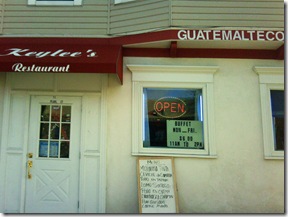
I snapped this photo as a friend and I drove down to Rinconcito Migueleño. I have no idea how long this has been around, but any place that references “guatemalteco” food is worth noticing. I’m hoping for some great hand-made tortillas. Here’s hoping.
So many places, so little time…
Solve the world’s food problems: Demand better tasting food.
Posted: December 12, 2008 Filed under: Food, Work | Tags: avocados, connecticut, Food, IBM, inland empire, local food, locally grown food, produce, san diego, smart planet, smarter food, smarter planet 9 Comments
My two worlds have collided this week: work and food.
At IBM right now, I’m deeply involved in the communications efforts supporting the “Smarter Planet” agenda. Basically, the premise is that the systems that make the world work – financial, food, health, water, traffic, etc. – are largely broken and need to be fixed. IBM’s point of view is that it takes technology, sure, but also policy and cultural change to really find solutions to these problems – to make them smarter.
This week, we’ve been focusing a lot on building smarter food systems. You can read through some of the content here for more background, but the essence is that as our food systems have become globally interconnected, it has heightened the potential risks associated with food safety, nutrition, affordability and availability.
Clearly, this topic of food interests me very personally. So allow me to be indulgent and offer some of my own perspectives on the topic. While many people far smarter and more qualified than I are working on this issue, I have but one point of entry to the topic: taste. Simply, I believe this country’s food problems can be solved with a greater emphasis on better tasting food. Trust me, I’ll explain. But first, some background:
I remember as a kid frequently driving to San Diego from my home in the Inland Empire – about 45 minutes East of Los Angeles. Anyone who has driven that stretch of the I-15 corridor to San Diego knows you pass miles and miles of rocky hills, largely covered by dark avocado trees. The avocado groves thrive in the warm hilly terrain and make the dry, often parched hills, look lush and verdant. Not long after one such trip, I went with my mom to a local produce market and was tasked with buying the avocados. Expecting to find avocados from some of the trees I’d seen on my last trip, I was surprised to find only avocados from Chile or Mexico.
If avocados grew commercially in abundance just miles from my house, why could I only buy ones picked from trees thousands of miles away?
Fast forward 20 years to my now hometown supermarket in Connecticut. It’s August, prime summer produce season in the Northeast, and yet all I find in my supermarket are tomatoes from California. (Ironically, it’s easier to find California grown avocados in Connecticut than in California, as this blogger also noted this week).
Clearly, something is wrong. How much money is being wasted sending food across the country when it’s grown around the corner? What kind of unnecessary energy is burned in the process?
With populations on the earth facing devastating food shortages, something feels wrong about shipping food across the globe to places fully capable of providing for its own.
Somehow we need to create an independent market for local agriculture that is capable of supporting the local population, as much as practical. We need market incentives that force supermarkets to make dramatic changes to how they source, distribute and market food.
How do we do that? the government’s solution, to date has seemed to hinge on farm subsidies. Just read Nicholas Kristof’s column from today’s New York Times to see the absurd results of those programs.
I have a different idea. Remember, I love food for food’s sake. So it always comes back to taste. And, I can’t help but think that peoples’ desire for better tasting food can, ultimately, help lead to the kind of systemic changes needed in our food supplies.
Trivial, you say? Well, let me explain.
Simply stated the closer food is consumed to the place it was grown, the better it tastes. That is an absolute rule.
So, as people yearn for better tasting food, they’ll ultimately yearn for more locally grown food. And as demand for locally grown food increases, demand (read: money) for local agriculture increases. And demand for local agriculture translates into incentives for supermarkets to stock local products. And stocking local products requires more efficient local distribution systems. Problem solved.
It all comes down to consumers’ understanding of what truly good food tastes like. For the most part, we’ve been complacent with two generations worth of mediocre food and have forgotten the link between local food and good food. But if we can begin to remember that linkage, the above scenarios begin to come true.
See how beautifully it all works out in the end? Who can’t get behind the idea of demanding better tasting food?
And that’s what I love doing. Hunting for great food, wherever it exists. And now it’s doubly good to know that my quests are contributing to a smarter food system.
Now, as a pay off for reading this post, a great little video from a colleague explaining why it’s important to know where your food comes from:
Mapping the best Latin food in Port Chester
Posted: December 7, 2008 Filed under: Food | Tags: Brazilian, Colombian, feijoada, Guatemalan, Latin, mexican, new york, paletas, peruvian, port chester, pupusas, Salvadoran, tacos, tortas, uruguayan 1 CommentI’ve decided to start using Google Maps much more to visually lay out the best food around. I’ll probably do this by topic and by location. So, first on the docket is charting all the good Latin restaurants in Port Chester. Here’s a start. This map will grow as I get around to loading it up with all the places I’ve been to. Right now, this represents about half of the places I’ve been to in PC.
Pupusa nirvana, finally
Posted: December 4, 2008 Filed under: Food | Tags: Guatemalan, migueleno, port chester, pupusas, rinconcito, Salvadoran 3 Comments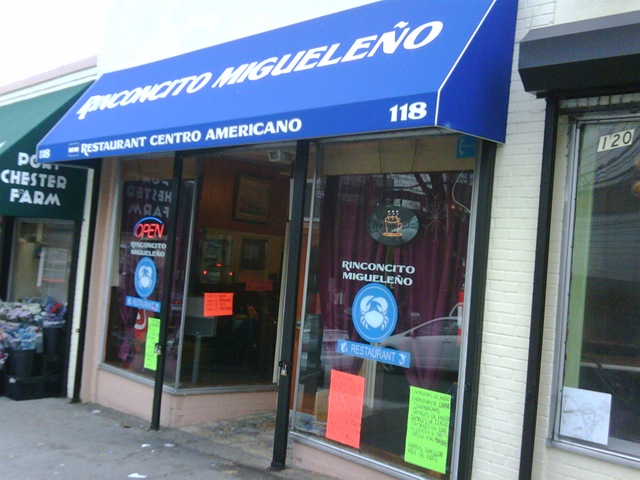
Sometimes, you just have a hunch.
As I drove down the street a few weeks ago in search of empanadas, I passed a new addition to this restaurant-packed stretch of Westchester Ave. It’s in the same location two other restaurants have occupied in just the last year. But something about that spiffy new blue awning told me it would be great.
After my taquito experience a few days ago, I took the opportunity to walk down the street and scout the blue awning restaurant – Rinconcito Migueleño – more properly. Grabbing a card, I vowed to return as soon as I could.
So today I made my way back, nestled into my seat and took a long look at their short menu. Migueleño is a Salvadoran-Guatemalan restaurant though the menu feels more of the former than the latter.
As tacos are the quality benchmark for any Mexican taqueria, pupusas are my benchmark for any Salvadoran restaurant. So I ordered two pupusas – queso con loroco and chicharrón. I threw in a chorizo taco to check out the Guatemalan side of the menu.
The pupusas were fantastic. They had a mildly crisp exterior, not tough, heavy, chewy or greasy – the usual culprits in a sub-par pupusa. The interior was soft with a strong masa flavor. The queso con loroco pupusa is comfort food at its best: a half-inch thick masa tortilla filled with hot stringy cheese punctuated with the herby loroco. The chicharrón pupusa was equally satisfying.
The vinegary slaw and tomato sauce/salsa that accompanied the pupusas were perfect too. providing the requisite sharpness to cut the richness of the pupusas. All in all, these were the best pupusas I’ve had anywhere around these parts – and every bit on par with the great ones I had from some of the pupuserias in San Francisco’s Mission District a few weeks ago.
Needless to say, this beats its Port Chester Salvadoran neighbors – Rinconcito Salvadoreño, El Tesoro II and Pupusa Loco – hands down.
The taco, on the other hand, was a disappointment. My favorite part about Guatemalan tacos is that they are usually thick, hand made tortillas. But Migueleño’s were made with standard Mexican tortillas. And while the chorizo filling is distinctly different from a Mexican chorizo, it’s just not worth going there when the pupusas are so good and you can get truly outstanding tacos only a few doors up the road.
All told, the pupusas will set you back $1.50 each, and the tacos another $2.50 each. The best bet is to get the $6.50 special, which comes with 2 pupusas, beans and plantains.
Rinconcito Migueleno
118 Westchester Ave.,
Port Chester, NY





 Adam Christensen